




Loading dock safety comes down to a few conditions that must be true before a forklift drives into a trailer: the truck is fully docked, the wheel chock is in place and the dock leveler is positioned. Vision AI checks these conditions from dock cameras before loading starts and while it continues, and if the chock is missing or the truck moves, it alerts the forklift operator heading into the trailer on their wearable. The Loading Dock Safety solution page shows each situation step by step.
This guide covers the main loading dock hazards, why manual checks are not enough on a busy dock and what to plan when you add camera-based checks to your docks.
Why loading docks are high-risk areas
A truck that pulls away early or creeps forward during loading can leave a gap between the dock and the trailer, and a forklift can fall into it. Add pedestrians at the dock edge, height differences between the trailer bed and the dock and limited visibility during reversing, and the dock becomes one of the most demanding areas of a warehouse.
The UK Health and Safety Executive's guidance on loading and unloading areas highlights several of these risks: varying heights between vehicle and bay platforms, the safe use of dock levellers, visibility for drivers and the risk of people falling from bays. Many sites already have rules for chocks, locks and dock lights. The challenge is making sure those rules are met every time, on every dock, on every shift.
Traditional loading dock controls and their limits
- Driver and operator responsibility: checking the chock and the lock is often left to the truck driver and the forklift operator. On a busy dock, one person's attention is the only safeguard.
- Dock procedures and signs: they define the rule but cannot confirm it was followed for a specific truck.
- Dock lights: a traffic-light system helps communication, but it depends on someone setting it correctly.
- Supervisor checks: supervisors cannot be at every dock door when several trucks are loading at once.
None of these provide a record of which condition failed at which dock, which makes it hard to learn from near misses.
How vision AI improves loading dock safety
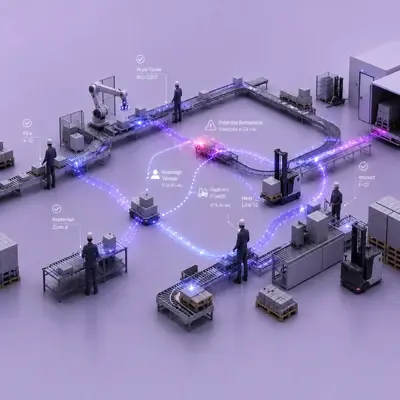
On the TIM INSPECT platform, loading dock safety uses fixed dock cameras and follows four steps:
- Verify docking. When the truck backs up to the dock, the camera checks its position, the wheel chock and the dock leveler.
- Release loading. Loading is released once the conditions are met. The camera keeps watching truck movement and the dock edge while loading continues.
- Alert when a condition fails. If the chock is missing or the truck moves, the AXION wearable of the forklift operator heading into the trailer vibrates and gives a voice alert, for example: "Chock not in place. Do not enter the trailer." The alert stays open until the camera verifies the condition again.
- Record the event. The event is recorded with a short video. The dock, the failed condition and the closing details are kept in one record.
The conditions in scope are full docking of the truck, the wheel chock being in place, the position of the dock leveler, truck movement during loading and pedestrians at the dock edge. The system does not stop the truck or the forklift by itself; it alerts the operator and records the event.
Short videos that make reviews concrete
Each record shows which dock and which condition an alert was opened for and when it closed, together with a short video of the event. That makes it much easier to review dock rules and site layout with drivers, operators and carriers, based on what actually happened rather than on recollection.
What to plan before installation
Camera angle at each dock
The camera must see the truck's position, the chock area at the rear wheels and the dock leveler. Whether an angle covers all three is reviewed together for each dock before installation; the final scope depends on the camera view.
Reusing existing cameras
Sites that already have cameras at the shipment door may not need extra cameras: dock safety can be added to the same cameras as an additional feature. Cameras installed for shipment verification can serve this scenario too.
Dock light and door integration
Where needed, the workflow connects to the dock light and door control. The scope of that integration is planned around the equipment on site.
Operator workflow
Alerts only help if they reach the right person at the right moment. Agree which operators work which docks, how AXION is worn on those shifts and what the operator does when an alert is open, for example waiting outside the trailer while the chock is placed.
Privacy
The system monitors zones and behaviour, not who the person is. Images are filtered and only the event moment is stored; privacy is designed in line with GDPR and KVKK.
Measuring results
Before a pilot starts, define the metrics to track together, such as alerts per dock and how quickly open conditions are closed, and evaluate the pilot against them. For the operational side of the same docks, Dock & Door Monitoring tracks vehicle arrivals, door use and loading progress in one workflow.
FAQ
Does the system stop the truck or the forklift?
No. It alerts the operator through AXION and records the event. Where needed, it connects to dock light and door control.
Which conditions does the camera check?
Full docking, the wheel chock, the dock leveler position, truck movement during loading and pedestrians at the dock edge.
Can we use our existing shipment cameras?
Often yes. Sites with cameras at the shipment door may not need extra cameras, provided the angle covers the chock area and the dock leveler.
How will results be measured?
The metrics are defined together before the pilot and the pilot is evaluated against them.
Next step
To review your dock layout, camera views and operator workflow, request a demo and we will agree on the docks and metrics for a pilot; the solution page shows the full flow.


