



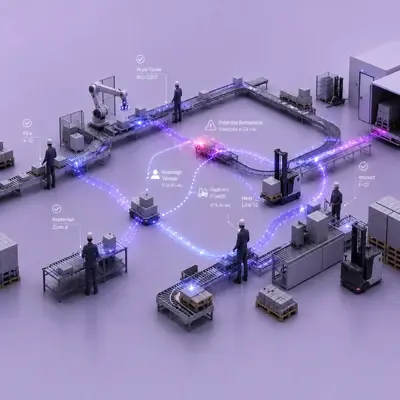



Tailgating detection closes the gap a card reader cannot see: when one person swipes a card and two walk through, a camera that counts people at the door can compare that count with the card-access log and flag the difference immediately. The same camera-based approach also spots doors left open, off-hours movement and unauthorized vehicle entry in protected areas, and sends the security guard a notification with the location and image, without using face recognition.
High-value stock areas and hazardous material stores are usually protected by card-access doors. The card controls who may open the door, not how many people pass while it is open. Off-hours movement is typically found later, by scrolling through recordings after something has gone missing. This guide covers why that happens and how the Unauthorized Entry scenario on TIM INSPECT reports rule breaks as they happen.
Why card access alone does not stop unauthorized entry
- Tailgating and piggybacking. A second person follows the cardholder through the door, often out of politeness rather than intent. The access log shows one entry; the area now holds two people.
- Doors left open. A propped or slow-closing door turns a controlled area into an open one, and the access system may not raise it as an urgent event.
- Off-hours movement. If nobody swiped in, the access system has nothing to report. Movement in a stock area at night shows up only in video, and only if someone looks.
- Searching after the fact. Reviewing hours of footage to find one event is slow, and by then the opportunity to respond has passed.
Traditional measures and their limits
Turnstiles and mantraps
Physical barriers that let one person through at a time are effective but expensive, slow down legitimate traffic and are hard to retrofit in warehouses and production areas.
Security staff at the door
A guard at every protected door is rarely practical, and a guard watching a wall of monitors cannot give every camera full attention.
Recorded CCTV
Recording is valuable evidence, but without analysis it is a tool for investigation, not for response.
How camera-based tailgating detection works
On the TIM INSPECT platform, the workflow has four steps:
- Define areas and hours. Protected areas, doors and allowed hours are set. Every assessment follows these rules.
- Spot the violation. Fixed cameras detect tailgating, doors left open, off-hours movement and unauthorized vehicle entry. No face recognition is used.
- Alert the security guard. As the event happens, the guard receives a notification on AXION with location and image, and assesses the situation on site.
- Record the event with its clip. The event is recorded with a short clip and matched with the card-access log. Only the event moment is stored.
Three typical events
| Event | What the guard receives | What is recorded |
|---|---|---|
| Tailgating | One card swipe at a card-access door, two people pass. Notification: "Entrance B: 1 card swipe, 2 people passed." with the door location and image. | The number of swipes is matched with the number of people passing; the difference is written to the event record with its short clip. |
| Door left open | A store door that should be closed has been open longer than the defined time. The guard is notified with location and image. | How long the door stayed open is part of the event record. |
| Off-hours movement | Movement in a stock area outside allowed hours, with no matching card record. The camera catches it as it happens, so nobody has to search recordings later. | The event is stored with its time and short clip and matched with card-access records. |
The system alerts and records; it does not lock doors or block passage by itself. The guard decides on site, and the record shows how each event was closed.
What to consider before deployment
Camera views at doors and areas
Counting people reliably requires a camera view that sees the whole door opening. The scope of what can be monitored depends on the protected areas and the camera views, so review them door by door.
Integration with card access
Tailgating detection depends on matching people counts with card swipes. Once that link with the card-access system is in place, each opening can be compared. The integration scope is planned around the access system on site.
Privacy and data protection
Camera monitoring in the workplace must be proportionate and transparent. The European Data Protection Board's Guidelines 3/2019 on processing personal data through video devices are a useful reference. In this scenario no face recognition is used: zones and behaviour are monitored, not identity. Images are filtered, only the event moment is stored, and the design follows GDPR and KVKK requirements from the start.
Position alongside existing security
This scenario is not designed to replace a security system or a security service. It is an additional capability on top of a TIM INSPECT setup already on site, working together with your card-access system.
If your concern is people entering hazardous zones such as robot cells or areas under suspended loads, the related Restricted Zone Detection scenario focuses on safety rather than security.
FAQ
How is tailgating detected?
The camera counts the people passing through the door. Matched with the card-access system, it shows when more than one person passed on a single card swipe, and the guard is notified.
Are people identified?
No. No face recognition is used. The system monitors how many people pass a door or when there is movement in an area, not who they are.
Does the system lock doors?
No. It alerts and records. The security guard is informed on AXION and assesses the situation on site.
Does it replace our security system?
No. It works alongside your card-access system as an additional capability.
Next step
To decide which doors and areas to monitor, explore the Unauthorized Entry scenario or request a demo with our team.


