



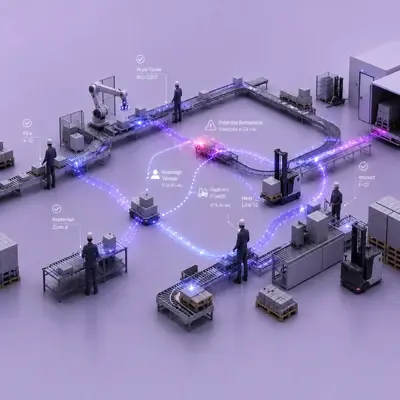




Mixed pallet verification does not have to mean scanning every carton by hand. If the pallet passes through a gate fitted with four cameras, the labels and barcodes on all four sides can be read in a single pass and checked against the order list before the pallet leaves. Four-side pallet scanning in TIM INSPECT does exactly that, and shows the operator which carton is missing, extra or wrong.
Mixed pallets are where shipping errors like to hide. Dozens of cartons, several SKUs, labels facing in every direction, and a pallet that has to leave on time. This guide covers why carton-level checks are hard to sustain, what the common alternatives miss and how a four-sided camera gate verifies the contents while the pallet keeps moving.
Why mixed pallets are hard to verify
On a single-SKU pallet, one label often tells the whole story. On a mixed pallet, every carton matters. Scanning each one with a handheld device takes time, and under shipping pressure that time is exactly what is cut first.
The physical layout adds to the problem. Labels on the back face are out of reach unless someone walks around or turns the pallet. A wrong carton tucked into the rear row can leave unread and is only discovered when the customer opens the delivery. At that point the cost is not just a replacement shipment but a claim, a credit note and a dent in trust.
There is also a documentation gap. When a customer reports a missing item, the shipper often has no record of what the pallet actually looked like when it left.
Common ways to check pallet contents, and their limits
Carton-by-carton handheld scanning
Accurate when done fully, but slow on large mixed pallets, and the rear face is easily skipped.
Visual checks against a pick list
Quick, but dependent on attention. Similar-looking cartons with different contents are a classic source of errors.
Weight checks
A scale can flag a pallet that is far off its expected weight. It cannot say which carton is wrong, and two errors can cancel each other out.
Conveyor scan tunnels and RFID gates
Scan tunnels work well for individual cartons on a conveyor, before they are palletised. RFID gates require every item to carry a tag. Neither fits every warehouse that builds mixed pallets from barcode-labelled cartons.
How four-side pallet scanning works
The four-side pallet scanning scenario runs in four steps.
- Get the order list. The expected contents of the pallet come from SAP or the warehouse management system, and the comparison runs against that list.
- Take the pallet through the gate. As the pallet passes, four fixed cameras read at the same time: every label and barcode on the four sides, and the carton count. The pallet does not need to stop or be turned.
- Alert the operator on a mismatch. TIM INSPECT matches the codes and count against the order list. Cartons that are not on the list, unlabelled or unreadable are flagged separately. When a carton is missing, extra or wrong, the AXION worn by the operator moving the pallet vibrates and shows on screen where the problem carton sits, for example "Unlisted carton · front side, bottom row, right". The operator fixes it and takes the pallet through again.
- Record all four sides. Photos of the four sides are added to the pass record and archived as proof of shipment, showing the state of the pallet at the moment it passed.
The result can connect back to SAP or the warehouse management system, so the pass record sits alongside the order. When a question comes in from a customer later, the photos show what left the building.
The scenario is the fixed-camera version of the bulk label recognition already used in a cargo transfer deployment, so much of the model work is in place. The results to measure are still defined at the start of each pilot.
What to plan before installation
Gate geometry and camera placement
Four cameras need a clear view of four faces at once. Gate width, pallet height, the travel path of the forklift or pallet truck and the minimum distance to each face all shape the design. Pass speed and camera placement are defined in the pilot around your pallet types and label layout.
Label layout and quality
Recognition depends on labels being visible on the outer faces. Agree on label position rules with the packing team where possible. Creased, wrapped-over or partly covered labels are flagged as unreadable rather than silently ignored.
Cartons in the inner rows
A carton buried in the middle of a pallet cannot be seen from any side. How to handle those positions, by method or by process, is assessed together during the pilot.
Lighting and stretch film
Stretch film can reflect light and blur barcodes. Even, diffuse lighting at the gate and a check of film type and wrapping practice help reading reliability.
Privacy at the gate
The cameras look at the pallet and its labels. When a person enters the frame, identity is not assessed, images are filtered and only the event moment is stored, in line with GDPR and local requirements.
If your flow also involves sorting parcels and checking shipping labels against pallet contents, the related cargo sortation and pallet verification scenario covers that step. Both run on the TIM INSPECT platform.
FAQ
Does the pallet have to stop to be read?
No. Reading happens while the pallet passes through the gate, with four cameras reading the four sides simultaneously.
What happens to a carton with no readable label?
It is flagged separately and shown to the operator. Cartons in inner rows that no camera can see are handled in a way agreed during the pilot.
Which systems does it work with?
The order list comes from SAP or a warehouse management system, and the result can connect back to it. The integration scope depends on the system you use.
Is the photo archive useful in customer disputes?
Photos of the four sides are stored with every pass as proof of shipment, so you can show the state of the pallet when it left.
Next step
To see how a gate would work with your own pallets, request a demo and we will review your pallet types, label layout and order list source together.


