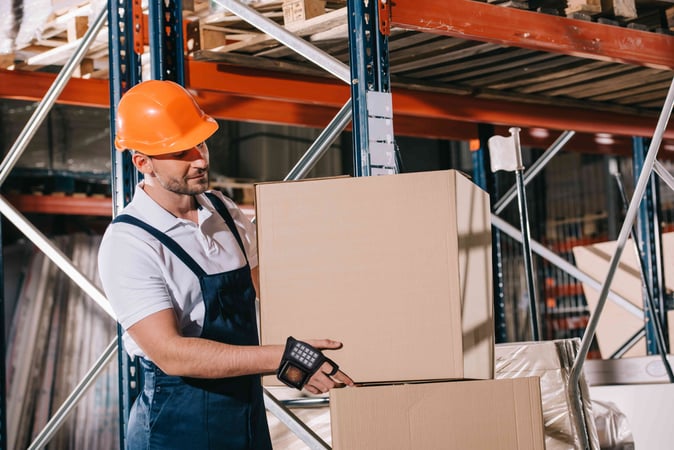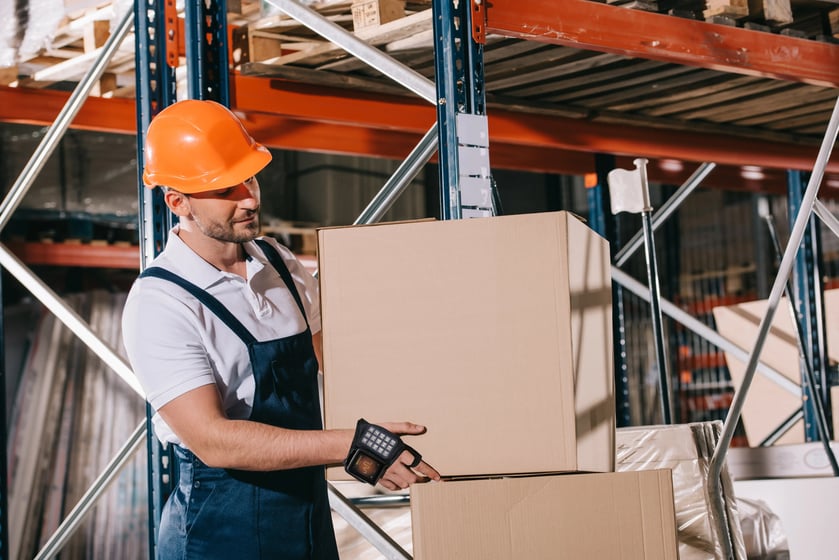
Hands-free picking cuts picking errors and time by removing the device from the picker's hands and putting verification into the pick itself. Every item is scanned, or seen, as it is picked, the system confirms instantly with vibration, sound or light, and the worker never stops to pick up, aim and put down a handheld. Fewer motions mean shorter cycles; instant confirmation means wrong items and wrong quantities are caught at the shelf instead of at packing or by the customer.
This guide looks at where picking time and accuracy are really lost, which hands-free technologies address each loss, and how to roll them out without disrupting a running warehouse.
Where picking errors and time come from
Before choosing a technology, it helps to break a pick into its parts. In a typical person-to-goods operation, each order line includes travel to the location, finding the slot, identifying the item, confirming it, counting the quantity and placing it in the tote or on the pallet. Losses hide in almost every step.
Common sources of picking errors
- Wrong item: similar packaging, adjacent slots, or variants that differ only by size or flavor.
- Wrong quantity: counting mistakes, especially with small items and multi-packs.
- Wrong location or skipped confirmation: the picker trusts memory instead of scanning, often because scanning is slow.
- Wrong lot or expiry date: critical in food, beverage and pharma, and almost impossible to check reliably by eye at speed.
Where the seconds go
- Picking up, aiming and putting down a handheld terminal, often several times per line.
- Reading small screens and typing quantities while holding items.
- Walking back to a station to solve an exception.
- Double-checking at packing because the pick itself was not trusted.
Notice the link between the two lists. When scanning is awkward, pickers skip it, and skipped confirmations become errors. Making confirmation effortless is therefore the single biggest lever for both speed and accuracy.
Hands-free picking technologies compared
| Technology | How it confirms a pick | Best suited for |
|---|---|---|
| Wearable barcode scanners (glove, wrist, ring) | Scan in the natural grip; feedback on the hand | High-volume each and case picking, mixed SKUs |
| Voice picking | Spoken check digits and quantities | Case picking, cold storage, long routes |
| Pick-to-light | Lights on the slot, button to confirm | Fixed, dense pick faces with fast movers |
| Vision verification | Camera recognizes the item, label or count | Items without reliable barcodes, quality and count checks |
| Wearable AI computers | Combine scanning, voice, vision and a small display | Complex or variable tasks that need guidance as well as confirmation |
No single option fits every zone. Many warehouses combine them: pick-to-light for the fastest movers, wearable scanning across the wider range, and vision for checks that a barcode cannot answer.
How hands-free picking cuts errors
- Confirm every pick, not just some. When the scan happens in the same motion as the grab, there is no reason to skip it. Item, location and quantity can be validated on every line.
- Give feedback the picker cannot miss. A vibration on the hand, a tone and a colored light work even in noisy aisles and without looking at a screen.
- Validate against live WMS data. Real-time, two-way integration means the system checks the scan against the current order, not a list downloaded at shift start.
- Check what barcodes cannot. Wearable cameras with OCR can read lot numbers and expiry dates, and vision can confirm damaged packaging or counts in a carton.
How hands-free picking cuts time
- No device handling. Both hands stay on the product and the tote.
- Glanceable instructions. A small display on the wrist or hand shows the next location and quantity without pulling out a terminal.
- Faster data entry. Physical keys on the wearable avoid on-screen keyboards for quantities and exceptions.
- Less rework downstream. When picks are confirmed at the shelf, packing can rely on them and second checks can be reduced.
- Better task allocation. Every confirmed scan becomes live data that can feed route and workload optimization.
Real result: Lactalis
At Lactalis, a dairy and FMCG operation with high product variety and shelf-life sensitivity, VEGA-X smart gloves were integrated with the site's Axata WMS for real-time, two-way data flow. Operators picked and handled products hands-free while every operation was validated instantly through haptic, visual and audio feedback. TIM FLOW managed task allocation and routes, and TIM PERFORM tracked performance. The reported outcome: 50% faster operations and 0% errors, with 100% accuracy and end-to-end traceability.
What the hardware needs to get right
Whichever device you choose, check it against the realities of a shift. Using TIM VEGA-X as a reference point:
- Weight and fit: VEGA-X weighs 45 g and sits on the hand, so it does not get in the way of gripping cartons.
- Range: short-, mid- and long-range scan engines, so the same glove can cover pick faces and higher rack locations.
- Battery: a replaceable battery, so a fresh pack goes in between shifts instead of a charging break.
- Input: a textile keypad on the glove lets the picker enter data while the display stays fully visible.
- Connectivity: Wi-Fi and Bluetooth, with no paired device required, plus SAP, Oracle, WMS and REST API integration.
- Beyond barcodes: OCR reading, expiry verification and damage detection on the device.
Where pickers also need spoken guidance or richer on-device AI, TIM AXION adds voice, vision and motion awareness in a wearable computer that can be worn on the hand or the belt.
Rolling out hands-free picking step by step
- Measure your baseline: lines per hour, error rate by type, and time spent on rework and exceptions.
- Choose a pilot zone with enough volume to show a difference within weeks.
- Integrate early: confirm the scan-to-WMS round trip and exception flows before go-live.
- Train on the feedback, not the device: pickers learn quickly what each vibration and light means.
- Compare and scale: review the same metrics after the pilot and extend zone by zone.
FAQ
What is hands-free picking?
It is order picking where the worker does not hold a scanner or terminal. Confirmation happens through a wearable scanner, voice, lights or cameras, so both hands stay free for the product.
How much can hands-free picking reduce errors?
Results depend on the starting point, but confirming every pick with instant feedback removes most wrong-item and wrong-quantity errors. Lactalis reported 0% errors after its rollout.
Is voice picking or a wearable scanner better?
Voice works well for long routes and case picking; wearable scanning gives item-level barcode confirmation at high speed. Many sites combine both, and wearable AI computers can offer both in one device.
Do we need to change our WMS?
Usually not. Wearable scanners and computers integrate with existing WMS and ERP systems, as Lactalis did with its Axata WMS.
Next step
To see how hands-free picking would work with your own SKUs and racking, book a demo with our team.