



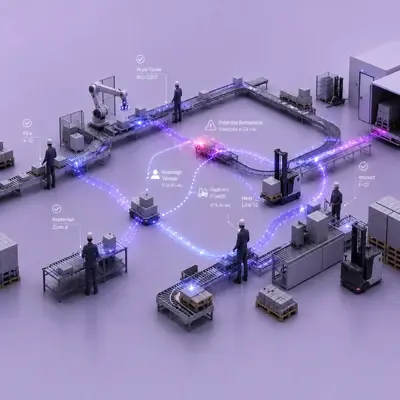

To measure cycle time and microstops reliably, you need to capture every cycle at every station, not a handful of stopwatch samples a year. Fixed cameras combined with vision AI can detect where each cycle starts and ends, separate waiting, searching and walking time, and flag a station that keeps running over takt. That is how cycle time and microstop measurement works in TIM INSPECT.
Most production teams know their planned cycle times by heart. Far fewer know their real ones, station by station, shift by shift. This guide looks at why microstops stay invisible, why classic time studies cannot fix that and what a camera-based approach changes on the floor.
Why microstops are an invisible capacity loss
A microstop is a pause of a few seconds: a worker reaching for a part that is not where it should be, waiting for the previous station, walking to fetch a tool. None of these is long enough to be logged as downtime. Yet repeated across hundreds of cycles per shift, they add up to a real capacity loss.
The second cost is less obvious. Without measured data, the question "which station is the bottleneck?" becomes a matter of opinion. Industrial engineering points to one station, the line leader to another, and improvement effort goes where the loudest argument is rather than where the time is actually lost.
How cycle time is usually measured, and where it falls short
Stopwatch time studies
A time study gives a careful snapshot of a station, often only a few times a year. It reflects the day of the study, the operator observed and the behaviour that changes when someone is standing there with a stopwatch.
Machine and MES counters
Counters record completed units and automated machine cycles well. Manual stations, however, rarely produce a clean start and end signal, and short pauses fall below any downtime threshold.
Manual logs and stop codes
Asking people to note every brief stop does not work in practice. The pauses are too short and too frequent, and the record ends up incomplete.
Reviewing recorded video
Some teams film a station and analyse the footage afterwards. It is insightful but slow, and it does not scale to every station on every shift.
How to measure cycle time and microstops with cameras
In the TIM INSPECT cycle time scenario, measurement runs continuously in four steps.
- Watch the stations. Fixed cameras cover the stations along the line. Each measurement is mapped to its station so it can be compared with the planned times held in the MES.
- Measure every cycle. The vision model determines the start and end of each cycle by itself. Non-value-added time such as waiting, searching for material and walking is separated out.
- Notify on deviation. When a station exceeds takt time several cycles in a row, or a build-up starts ahead of the line, the shift supervisor is notified on AXION with the station details, for example: "Station 3 is running late. Last cycle 46 seconds." A single long cycle does not trigger an alert.
- Report at the end of the day. The time breakdown and stop reasons are reported by station and feed continuous improvement work.
The difference from a time study is coverage. Instead of a few measurements a year, every cycle of the shift is recorded. The gap between planned and actual time becomes visible per station, and the bottleneck discussion can start from data.
What the supervisor sees during the shift
Picture a four-station line with a 38-second takt. Station three has run 46 seconds for three cycles in a row and the rest of the line is starting to wait. The supervisor's AXION vibrates with the station number and the latest cycle time. They walk to the station, find the cause, perhaps a material bin placed too far away, and resolve it while the shift is still running. The run of over-takt cycles is reported, and the station's cycle times stay on record for the end-of-day review.
What to consider before installation
Camera angles
Each camera must see the point where a cycle visibly begins and ends: a part entering the fixture, a unit leaving it. One camera can sometimes cover two neighbouring stations; that depends on layout and occlusion by racks or people. The scope of measured times is finalised around the camera angles.
Thresholds that people trust
How many over-takt cycles in a row should trigger a notification? What counts as a build-up? Thresholds are set together during the pilot. Too sensitive and supervisors start ignoring alerts; too loose and the system says nothing useful.
Station, not person
Measurement and reporting are done by station, not by individual. The goal is to reveal bottlenecks and non-value-added time, not to compare workers. Introducing the project together with employee representatives is strongly recommended.
Privacy
Zones and actions are observed rather than identity. Images are filtered and only the event moment is stored, and the design follows GDPR and local data protection rules from day one.
MES integration
Planned times come from the MES so that measured cycles can be compared against them. Agree early on which lines, products and planned times will be used for the comparison.
If the losses you are chasing sit at a machine rather than at a manual station, the related machine utilization scenario classifies running, waiting, setup and fault states from video. Both are part of the TIM INSPECT platform.
FAQ
Is cycle time measured per person?
No. Measurement and reports are per station. The aim is to make bottlenecks, build-ups and non-value-added time visible, not to rank workers.
Which times are measured?
The start and end of each cycle, waiting, searching for material, walking, build-ups between stations and deviation from takt time.
When is a notification sent, and to whom?
When a station exceeds takt several cycles in a row or a build-up starts ahead of the line, the shift supervisor receives it on AXION. A single long cycle is not enough to trigger it.
How does it work with the MES?
Cycle times measured from video are compared with the planned times in the MES, so the gap between plan and reality is visible station by station.
Next step
If you would like to discuss your own bottleneck with measurements in hand, request a demo and we will look at your stations, takt time and camera views together.


